M.S. Candidate: Nevin Şehbal Hekimoğlu
Program: Multimedia Informatics
Date: 30.04.2026 / 14:30
Place: A-212
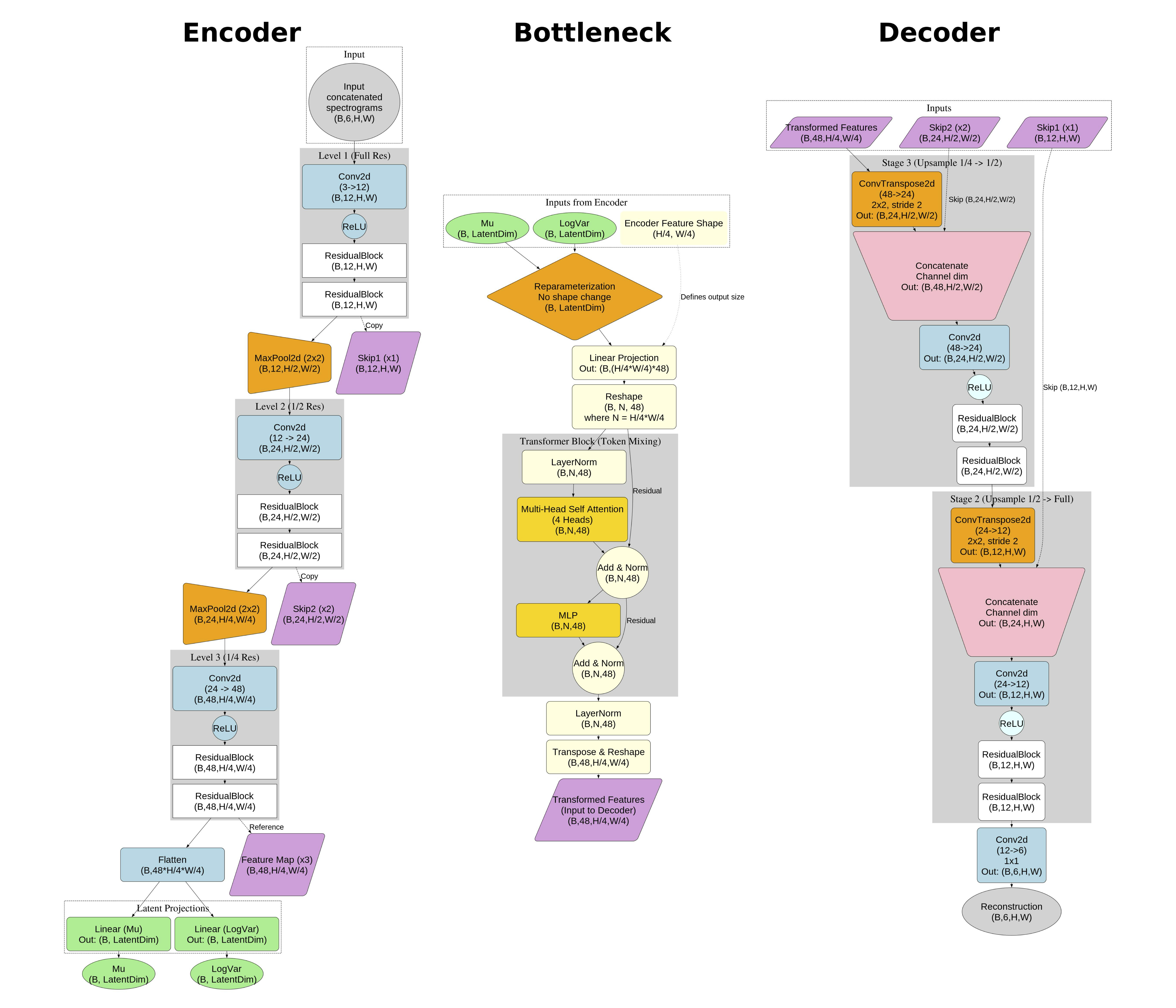
Abstract: Reliable characterization of strong ground motion variability is fundamental at every stage of modern seismic hazard assessment. However, the empirical record remains sparse for many critical combinations of source, path, and site conditions. This thesis explores how well a data-driven approach can model station-specific strong ground motion and develops a structured evaluation framework to quantify the answer. On the modeling side, an attention-enhanced variational autoencoder (VAE-Attn) is proposed that encodes three-component NGA-West2 acceleration waveforms as six-channel STFT spectrograms and learns a compact latent representation through a convolutional encoder augmented with an attention-based bottleneck. A station-aware latent sampling strategy produces site-specific ensembles from limited per-station data by using station-level statistics within the Gaussian latent space, implicitly capturing amplification characteristics without explicit site parameters. On the evaluation side, a framework is proposed that combines time-domain validation (peak ground acceleration, significant duration, coefficient of variation) with pseudo-spectral acceleration (PSA) analysis through two-dimensional intensity-shape binning and period-wise median comparison. The framework operates at two levels: an uncorrected site evaluation across real, reconstructed, and generated records that measures spectral accuracy, and a rock converted evaluation in which all datasets are converted to a common rock reference (Vs30 = 863 m/s) for direct benchmarking against physics-based simulations from the Southern California Earthquake Center Broadband Platform. The evaluation is applied to five Southern California stations spanning Vs30 values from 244 to 927 m/s. Results show that the VAE-Attn model produces waveforms with PSA distributions and time-domain properties consistent with real recordings, and that the data-driven approach achieves performance competitive with physics-based simulations, offering a complementary tool for site-specific strong ground motion modeling.