M.S. Candidate: Türkan Simge İşpak
Program: Multimedia Informatics
Date: 12.06.2026 / 14:00
Place: A-212
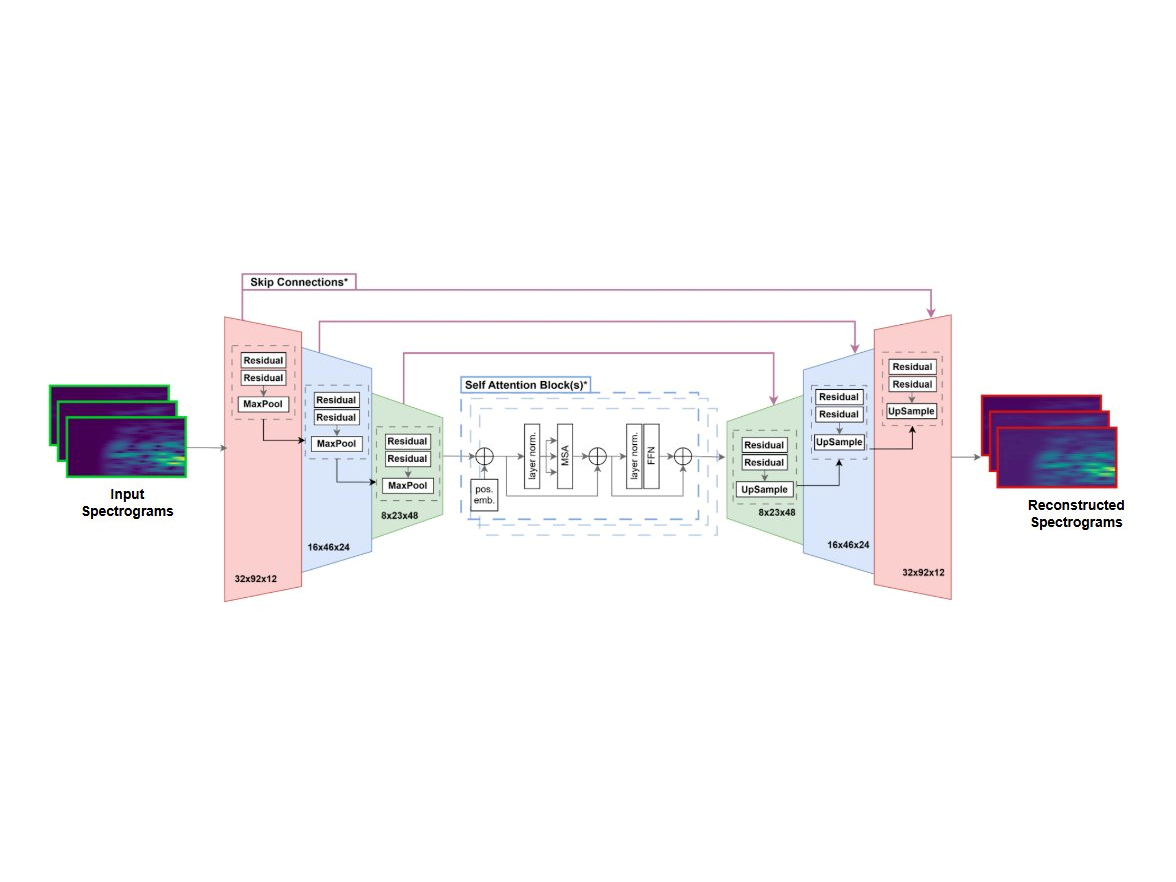
Abstract: Earthquake Early Warning (EEW) systems depend on rapid and reliable detection of Primary (P) waves to provide alerts before the more destructive Secondary (S) waves arrive. Detecting P-waves in strong motion accelerograms presents particular challenges due to high noise environments, recording artifacts, and the scarcity of labeled datasets that limits the applicability of supervised deep learning methods. This thesis proposes a self-supervised P-wave detection framework based on Variational Autoencoders (VAEs) trained exclusively on P-wave segments from 648 recordings of the Turkish National Strong Motion Network. The VAE learns to reconstruct P-wave structure and fails on non-P-wave inputs, enabling detection through a sliding-window mechanism that computes Normalized Cross-Correlation (NCC) between input and reconstructed spectrograms. A supervised ResNet baseline provides a benchmark for strong detection on this dataset, achieving an Area Under the Receiver Operating Characteristic Curve (AUC) of 0.97. A time-domain convolutional VAE matches this result without requiring labeled noise examples. The framework is then extended to spectrogram representations, where a systematic grid search across 492 configurations of four VAE architectures reveals an inverse relationship between reconstruction quality and detection performance. Attention mechanisms achieve the best detection (AUC 0.875) by enforcing reliance on global context, while skip connections degrade detection through overgeneralization despite yielding the lowest reconstruction error. Training procedure modifications further improve the Attention VAE to AUC 0.998, exceeding all supervised results and demonstrates robustness to temporal shifts in P-wave onset position, supporting potential deployment in EEW applications.