M.S. Candidate: Laya Moridsedaghat
Program: Data Informatics
Date: 03.09.2026 / 13:30
Place: A-212
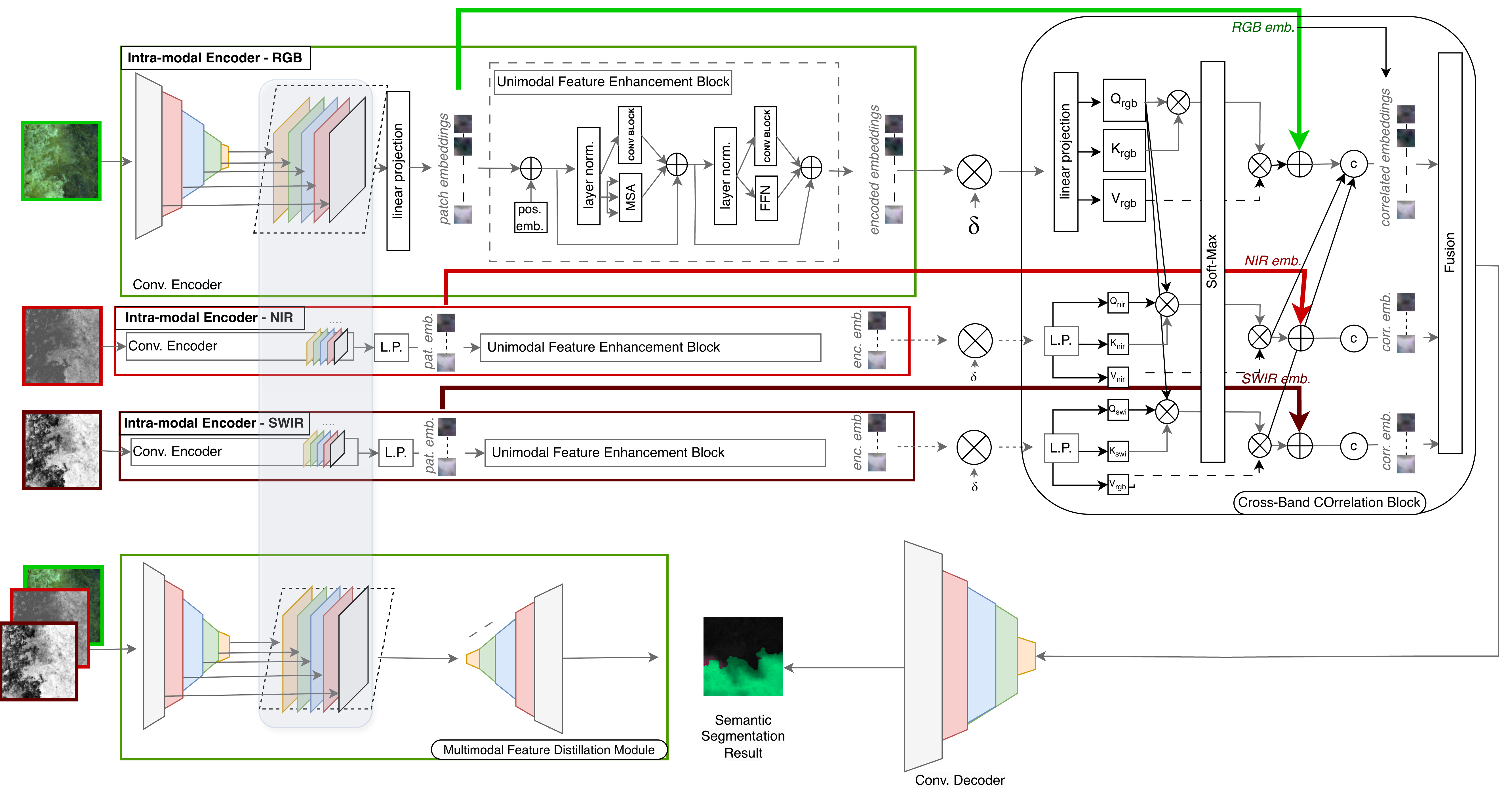
Abstract: Multimodal remote sensing semantic segmentation can benefit from combining different types of spectral information, such as RGB, near-infrared (NIR), and shortwave infrared (SWIR) bands. Since each modality provides different information about the same area, using them together can improve segmentation performance. However, in real-world applications, one or more modalities may be unavailable because of sensor failures, differences in data acquisition time, or incomplete observations. This can reduce the reliability of models that depend on having all modalities available. This thesis proposes the CBC-Distilled, an efficient multimodal CNN–Transformer model developed based on the previously proposed CBC architecture. The aim is to improve the model’s ability to handle missing modalities while reducing its computational cost. In the new architecture we use a feature distillation strategy to transfer feature level knowledge from a complete-modality teacher branch to unimodal student encoders during training. The cross-band correlation block is used to model interactions between homogeneous spectral bands and enhance multimodal feature fusion. Random modality masking is also applied during training to expose the model to different missing-modality situations. The teacher and auxiliary branches are removed during inference, keeping the final model lightweight. Experiments on DSTL dataset show that the proposed model improves the F1 score compared with the CBC baseline while using fewer parameters and lower computational cost. Overall, the proposed model provides a good balance between segmentation accuracy, robustness to missing modalities, and computational efficiency.