Ph.D. Candidate: Ekin Sağlıcan
Program: Medical Informatics
Date: 24.12.2026 / 16:00
Place: A-212
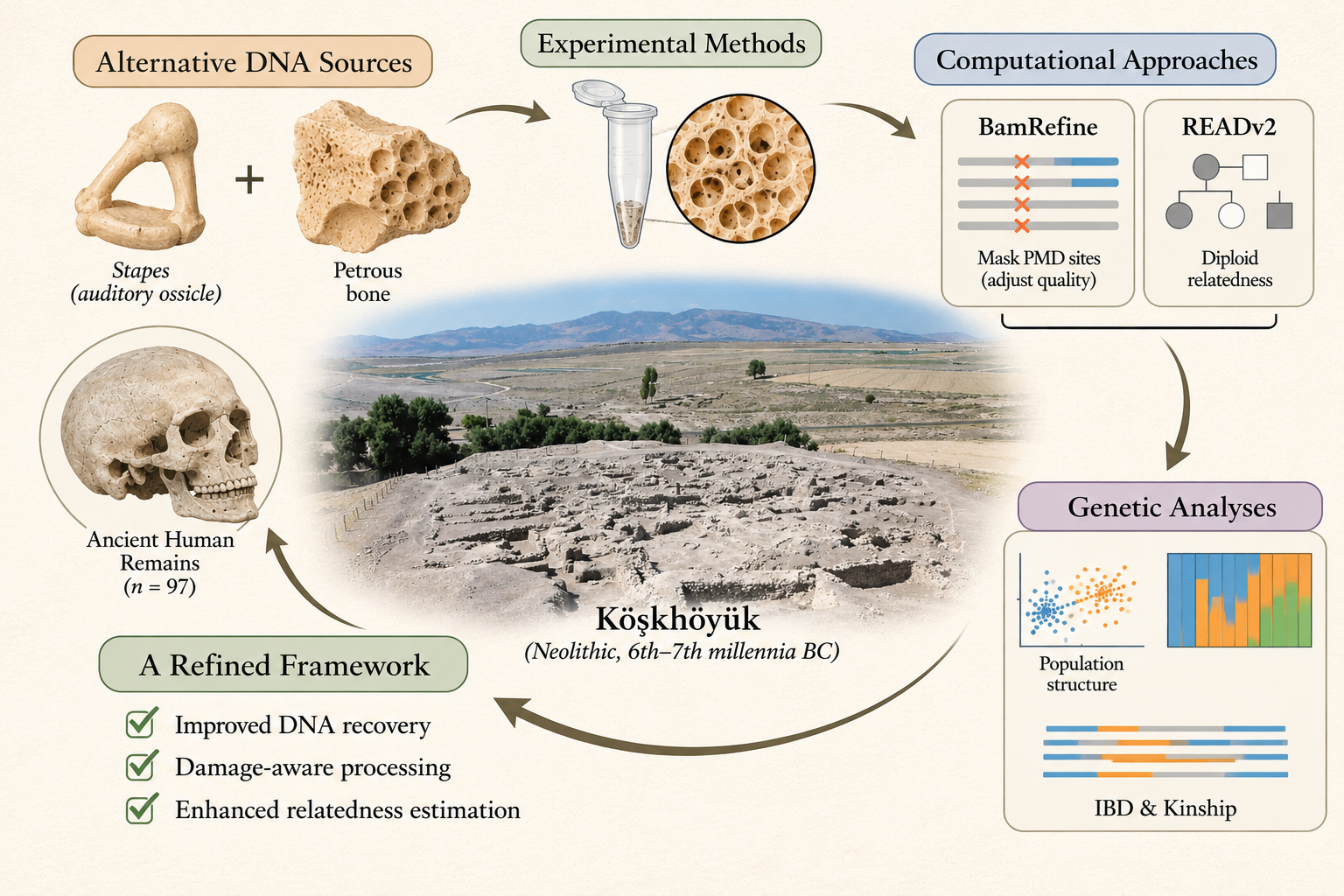
Abstract: Ancient DNA (aDNA) analysis provides an opportunity to investigate the genetic history of past populations and reconstruct evolutionary and demographic processes. However, DNA degradation, fragmentation, and post-mortem damage present major challenges to the recovery of reliable genetic information. Therefore, optimizing both experimental and computational approaches is essential for maximizing the information obtained from archaeological remains. Although petrous bones are widely recognized as valuable sources of endogenous DNA, this thesis suggests the usage of a promising alternative material, auditory ossicles, particularly the stapes, due to their high mineralization, osteocyte density, and limited bone remodelling.
In addition, computational approaches for processing aDNA require careful consideration of the characteristics of aDNA such as post mortem damage. This thesis introduces BamRefine, an approach that selectively masks PMD vulnerable sites and adjusts base quality scores accordingly, as an alternative to conventional read trimming method. Furthermore, downstrean aDNA analysis methods from low-coverage genomic data remains challenging. To address this, a diploid implementation of READv2 is evaluated against conventional pseudo-haploid approaches to improve relatedness estimation.
These methodological developments are applied to 97 human remains from Köşkhöyük, a mostly Neolithic archaeological site in Central Anatolia, dating primarily to the sixth and seventh millennia BC. By integrating experimental comparisons, computational evaluations, radiocarbon dating, population genetic analyses, and biological relatedness estimation, this research aims to establish an improved framework for archaeogenomic investigations. Ultimately, the study seeks to develop new methodologies to investigate the genetic structure and biological relationships of the previously genetically uncharacterized Neolithic population of Köşkhöyük.