Ph.D. Candidate: Eray Öntaş
Program: Medical Informatics
Date: 02.09.2026 / 14:00
Place: A-212
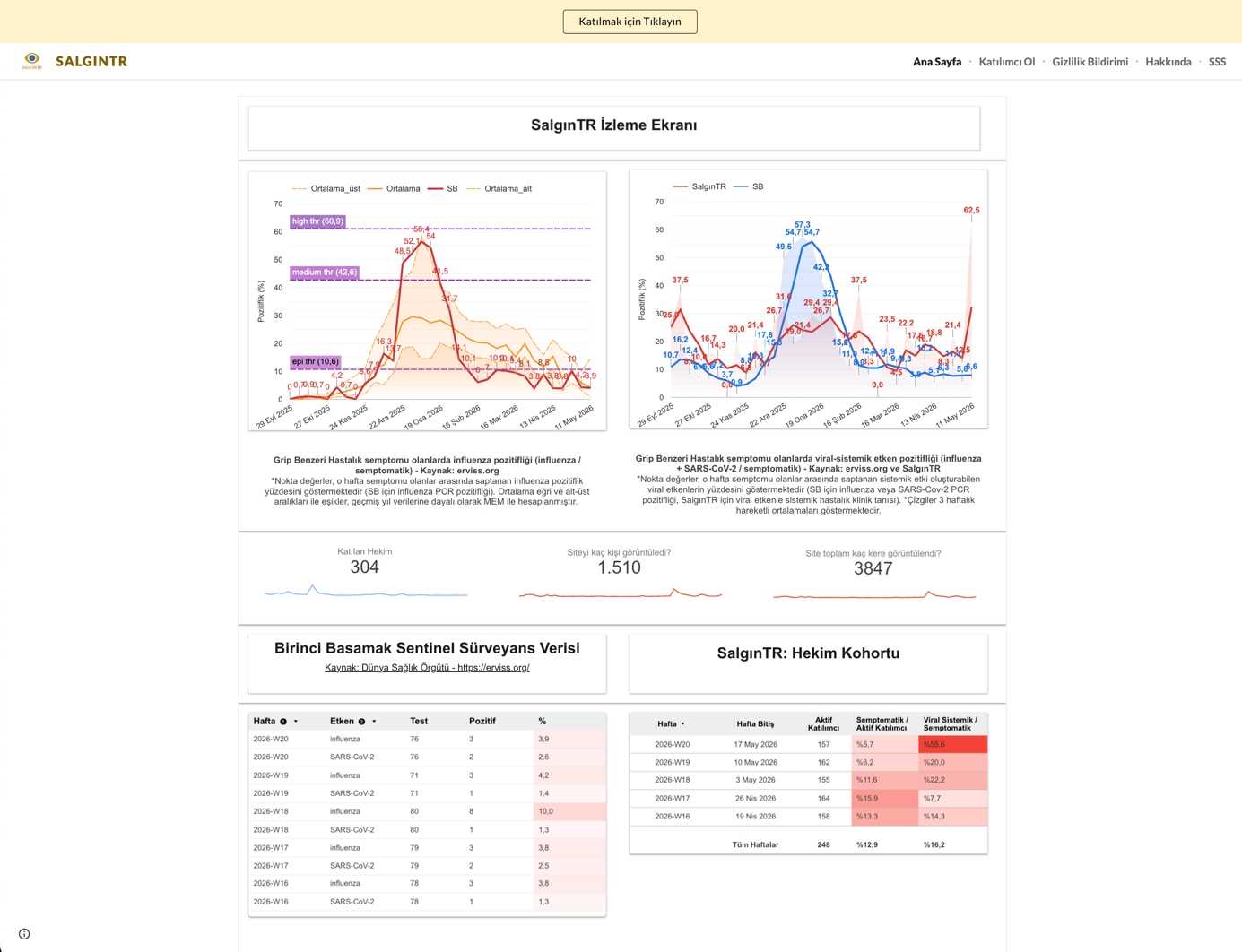
Abstract: Influenza surveillance in many settings rests on sentinel networks that are laboratory-anchored but narrow, slow and costly to run. We developed SALGINTR, a physician-based digital participatory system in which physicians self-report their own weekly influenza-like illness (ILI), and it was evaluated against the national sentinel stream over the 2025/26 season (ISO weeks 40/2025 to 20/2026, 33 weeks) in Türkiye. Physicians reported each week through a secure work-flow, recording their own symptoms and assigning each ILI episode to an agent-cluster scheme by clinical diagnosis, with episodes consolidated by the physician's new-versus-continuing declaration. Individual-level determinants were fitted with shared-frailty recurrent-event and generalised linear models on pre-specified adjustment sets; reporting selection was tested against baseline characteristics rather than assumed absent. The participatory signal was benchmarked against sentinel positivity by phase-specific correlation, epidemic-week discrimination and a six-detector aberration ensemble. Of 304 registered physicians, 248 (81.6%) reported at least one week, contributing 4,729 person-weeks and 497 ILI episodes; the cumulative attack rate was 77.4%. ILI risk fell with age (HR 0.85 per decade, 95% CI 0.75–0.96) and rose with a school-age child in the household (HR 1.36, 1.06–1.75). The participatory and sentinel series agreed in the pre-epidemic phase (r = 0.89) and discriminated epidemic weeks (AUC = 0.77, 95% CI 0.58–0.93), with substantial alarm concordance (κ = 0.835). A low-cost (100 USD) physician panel tracked the season in near-real time and agreed with sentinel surveillance where the design allows, supporting participatory reporting as a complement to, not a replacement for, laboratory-anchored networks.