M.S. Candidate: Umut Tatlıcı
Program: Information Systems
Date: 22.12.2026 / 14:00
Place: A-212
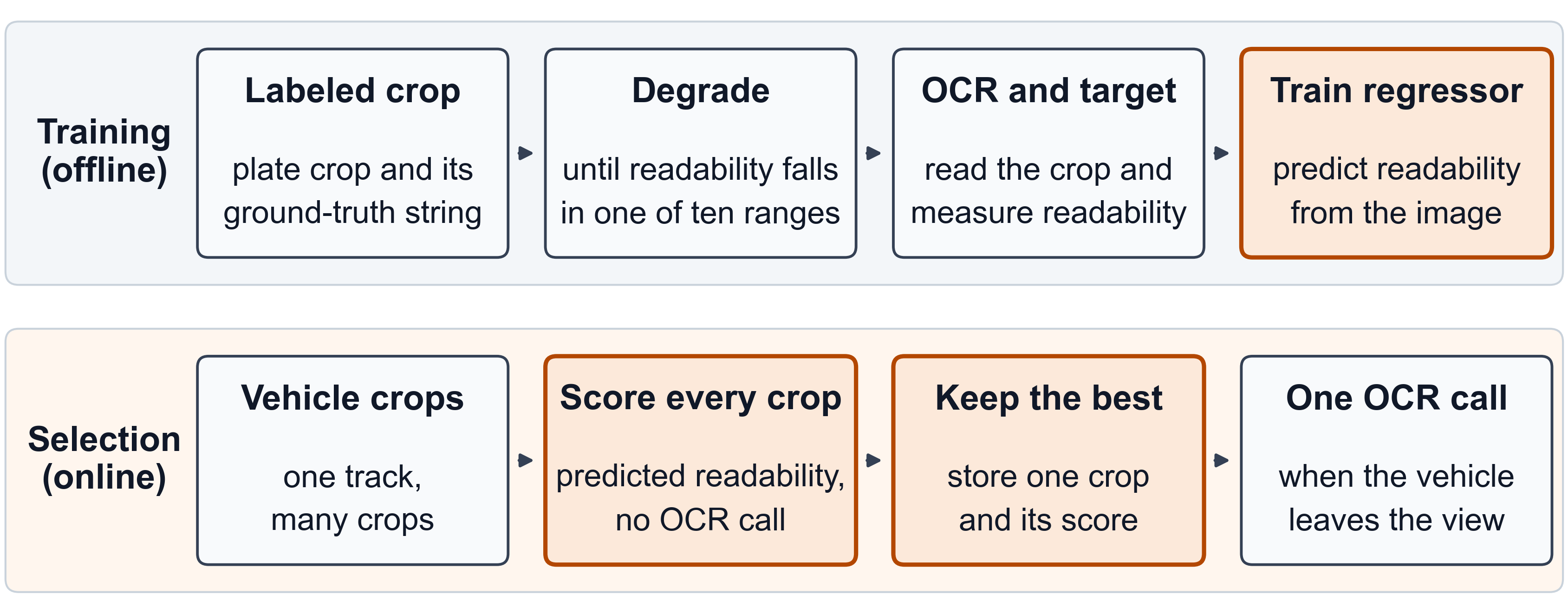
Abstract: A license plate recognition system may observe each passing vehicle in several images, each giving one plate crop, but reading every crop with optical character recognition (OCR) can exceed the computational budget of an edge device. This thesis proposes LegiPlate, a lightweight convolutional neural network (CNN) that predicts how accurately the OCR model will read each crop, so that OCR reads only the crop with the highest score. Readability is measured using normalized Levenshtein similarity between the OCR reading and the plate string, as Jaro similarity scores shortened readings too highly. Training samples are degraded to cover ten readability ranges evenly. LegiPlate reduces the image resolution early and weights local quality estimates. It was trained solely on Turkish plates and evaluated on simulated vehicle tracks. On tracks with capture failures from several sources, its selected crops were read exactly in 66.8% of the Turkish and 68.7% of the German tracks, compared with 50.0% and 51.5%, respectively, for the largest-crop rule. On a representative low-power embedded GPU board, LegiPlate scores a crop in 1.07 ms, 1.8x faster than a CNN regressor adapted from earlier work. In a load model, performing one OCR call per vehicle allows 15 vehicles in view to fit within a 100 ms frame at average load, against two when every crop is read.