M.S. Candidate: Gamze Cengiz
Program: Cognitive Science
Date: 04.09.2026 / 10:00
Place: A-212
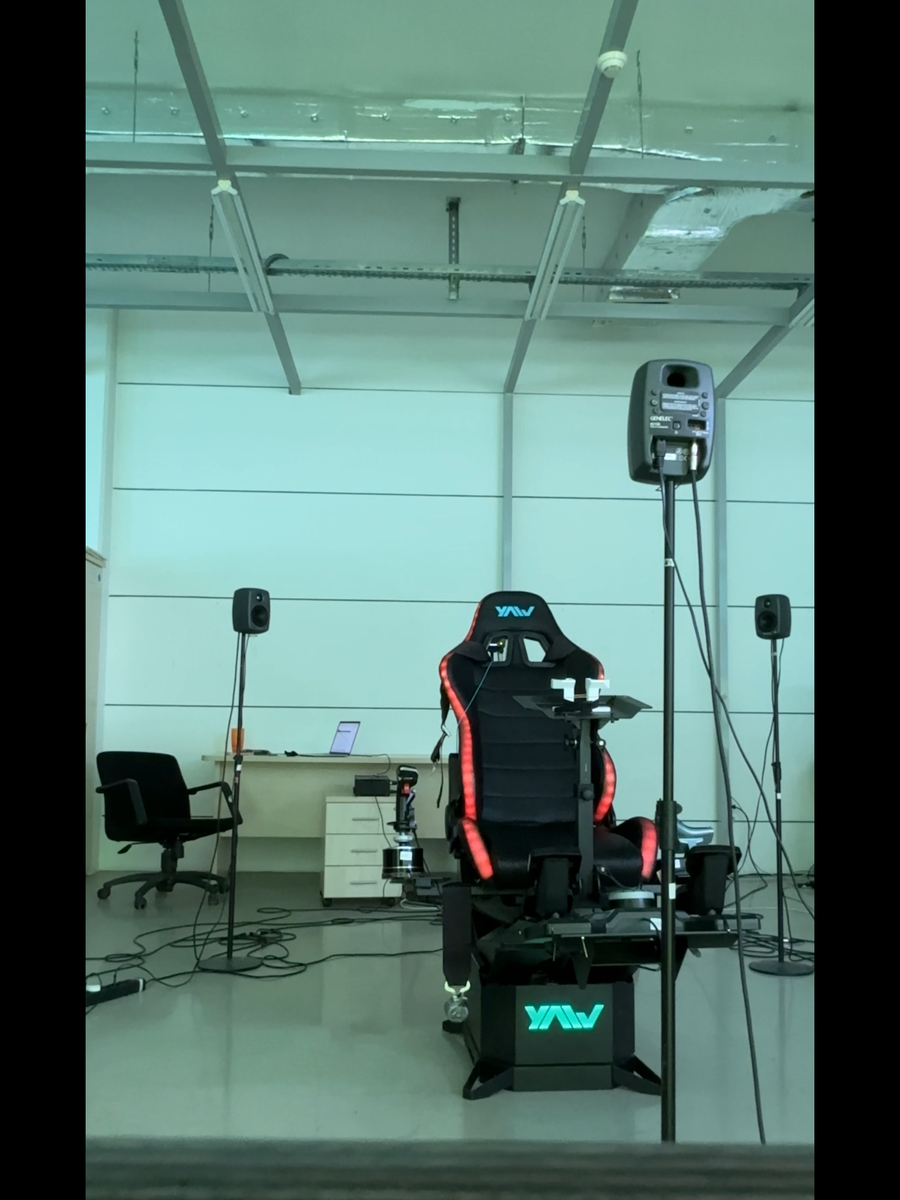
Abstract: Spatial disorientation (SD) is a perceptual phenomenon affecting pilots, implicated in roughly one-fifth of USAF Class A aviation mishaps. While the vestibular, visual, and auditory systems collectively maintain spatial orientation, the potential of spatially controlled auditory stimuli as SD countermeasures remains under-explored. This thesis presents the design, protocol, and findings of an experiment investigating which spatial audio condition and stimulus type most effectively modulate SD induced by the somatogyral illusion. Twenty participants underwent 1-minute yaw rotations in a Bárány chair at 40degrees/s, while exposed to three stimulus types: pseudo-speech, low-frequency slow bursts, and windowed white noise pulses, delivered through an 8-loudspeaker horizontal ring controlled via Vector Base Amplitude Panning (VBAP). Two spatial conditions were examined: a static 0 degree frontal azimuth point source and a continuous panning condition with congruent and incongruent rotation directions. Multimodal physiological data including EEG, EOG, ECG, fNIRS, and eye-tracking were recorded, alongside behavioral joystick measurements reflecting the subjective experience of SD. Outcome measures included nystagmus slow-phase velocity, alpha, theta and beta band EEG activity, temporoparietal junction activation via fNIRS, SD duration, and perceived rotation direction. Results indicate that the modulation is asymmetric: congruent panning reliably strengthened the post-rotatory response, producing significantly larger slow-phase velocity than incongruent panning and a significant reduction in left temporoparietal-junction oxyhemoglobin relative to silence, while no condition including the static point source reduced the response below a silent-control baseline. This pattern was most clearly detectable for the pseudo-speech stimulus.